Showing posts with label running. Show all posts

Monday, February 13, 2012

Cross Country Nationals 2012: Race Recap

Dear USA Track and Field:

Let me start off by saying how much I appreciate your continued support of Masters running (although something has to be done about the age-grading crap). Staging championship events at multiple disciplines allows for competitive fields all year round and gives people an opportunity to excel at their best/favorite events. Particularly, placing the Masters cross country championships in conjunction with the Open and Junior championships, provides a full day of fun for racers and spectators.

This past weekend, I had the pleasure of attending the Cross Country championships in St. Louis. Kudos to the organizing committee, they staged an excellent race.

The host hotel was convenient to the race site. The staff was accommodating. We really enjoyed the free breakfast.
Nothing like a gigantic sign to make you feel welcome.
The staff: don't they look like they stepped out of the movie "My Fair Lady"?
I realize the weather is beyond the control of mere humans, but… It was deplorable! When I woke up race morning and walked outside, I saw that it snowed over night.

Race morning this year.
Race morning last year.


In the mid-West, there is no such thing as absolute temperature. In the winter, they go by “wind-chill factor” and in the summer the “heat index”. I found this really cool Java script calculator that computed the wind chill factor on Saturday as 0 degrees (16 degree air temperature with 20 mph wind). That is mighty cold! I am sure you felt the nip in the air while attending the race. Did you notice that there weren’t very many spectators? They were at home drinking hot coffee.
The flags are blowing in the wind
My teammates and I had a lot of discussion about what to wear during the race. Shorts? Tights? Gloves?  I opted for tights over shorts, a heavy long sleeved shirt with my singlet over it, two pairs of gloves, wool socks and a hat. I was still cold! My crazy teammates wore much less clothing.

Pre Race: Lydia,
please put some clothes on!
After,  bundled up!

I am very psyched that I won the race. But even better, my teammates Mary Alico (4th) and Lydia Dissly (8th) kicked butt and we won the team competition.
I could barely lift my arms with those heavy boxing gloves.
We stuck around to watch the Masters men run. It was unpleasantly cold! While waiting for the men to pass by, we huddled around this tiny heater. I actually tried to crawl into it, but I couldn't fit.

Four hours after the race, my toes were still thawing out. We finally ventured out mid-afternoon to do some sightseeing.
The famous St. Louis arch.
USATF, if you insist on keeping the cross championships in February, I formally request that it be moved somewhere warm. Most of the country is blanketed in snow this time of year. A warm weather respite in a family friendly venue would do a lot to boost your participation and spectator numbers. Might I suggest moving the race to San Diego again? Or, Florida? If you do, I will send you this commemorative snow globe.
Ok, so I didn't actually buy this because I only had carry-on.
Sincerely,

Joanna Zeiger


Tuesday, January 24, 2012

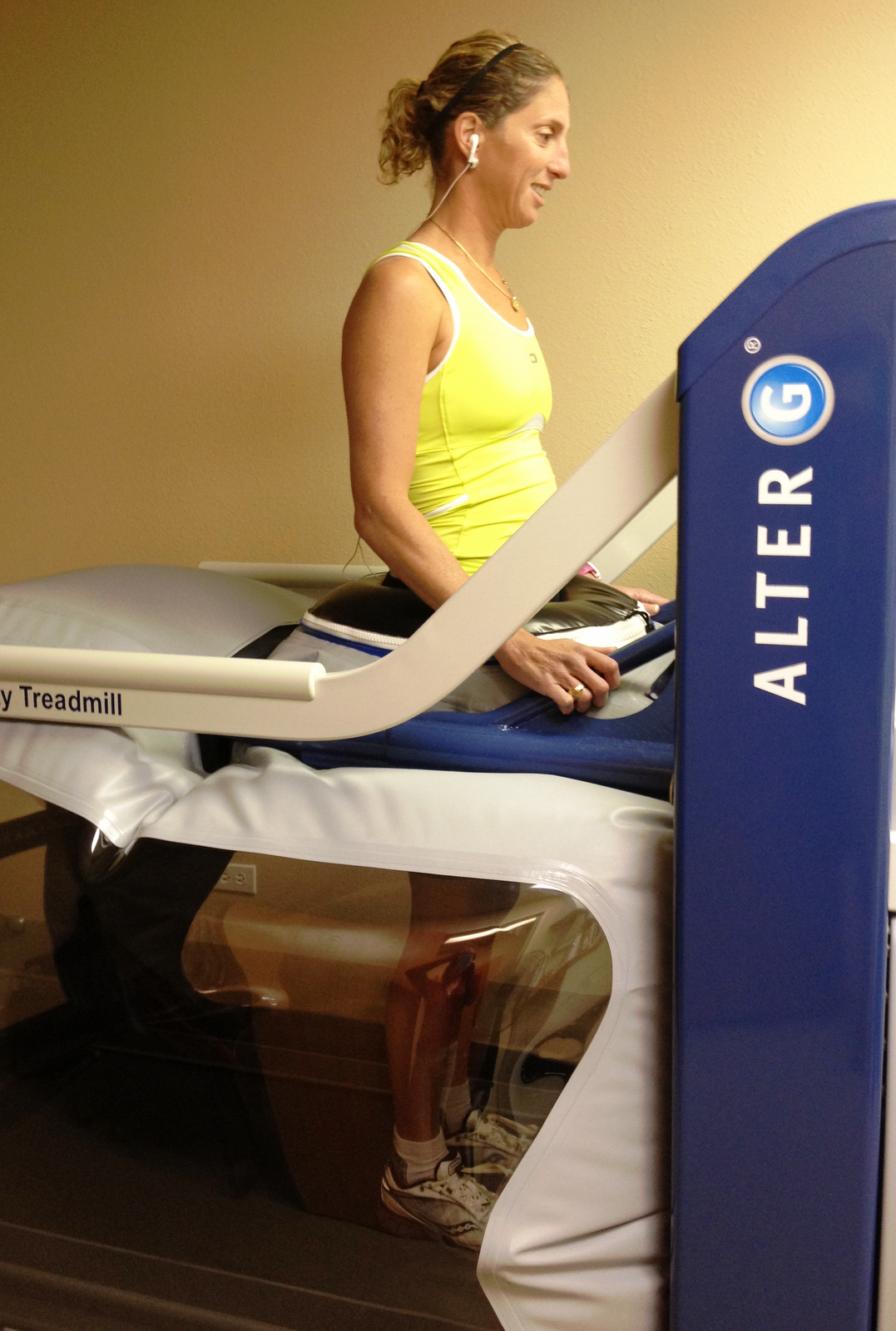
Defying Gravity: Running on the Alter G treadmill

In running circles, the Alter G treadmill is all the rage. Differential air pressure allows a person to run at various percentages of their body weight all the way down to 20% of full body weight. What a revolutionary idea, and the implications for rehab and recovery are endless. According to the Alter G website, their treadmill is, “a highly effective athletic conditioning tool for both recreational and competitive athletes by allowing the user to train longer, run faster, gain additional strength, and enhance cardiovascular performance while minimizing impact and stress on their joints.” And I thought it was just a cool toy.

A few short months ago, Boulder had nary an Alter G. It was an extravagance normally reserved for professional sports team, the Olympic Training Center and elite running groups. Now, Boulder boasts three of these monstrous machines.

I have had the pleasure on running on an Alter G at Altitude Physical Therapy (thanks Bob Cranny!!). The first time was just for kicks and the second time I ran an interval session. With cross country nationals around the corner, I need to channel my inner speed because at 8K this race is quite short. With marathon training and racing barely behind me, I realize that I am at high risk for injury if I do too much too soon.  The Alter G is a perfect compromise – it gives me the ability to train at faster paces without the dangers inherent in traditional speed work.

Here’s how it works.
How hot are these? I'm thinking about getting some for casual wear.
1.    Put on the neoprene shorts with the funky zipper. This is how you are locked into the treadmill. It is akin to running in half of a wetsuit. Your legs will sweat. A lot.

2.    Zip yourself into the cockpit. Yes, that is what they call it. I looked it up. I had no idea what it was called. Plastic thingy?
   
Step into the opening...     ...and then zip in.
3.    Stand still while the treadmill calibrates your weight. Fortunately, it does not tell you the weight, so you can remain in ignorant bliss.
I'm getting weighed. 
4.    Increase the speed and/or incline as you would on any treadmill. Choose your desired weight reduction. It decreases in 1% increments. On my first run, I played around with different decrements in weight down to 65%. For my interval run, I chose 80%.

5. Have fun running at paces you would never see on the track or on the road.

Now, I am not a huge fan of treadmill running. It is not the boredom that makes treadmill running unsavory. Nope, it is the fear of falling off the back coupled with how crappy my legs feel due to the fact the treadmill changes my form. I tend to arch my back which causes an anterior pelvic tilt which causes me to over stride which causes my glutes to stop firing.You get the gist. It sucks.

The Alter G combats both my fear of flying off the back and keeps my hips in good position. Being locked in really makes a huge difference. I could grab my drink, wipe my face, and play with my iPod with reckless abandon (and sometimes all at once!) all with perfect form (well, in my mind it was perfect and there was nobody there to refute it). I did not feel like I was over striding and my normally fast leg turnover got a boost.

I'm not coordinated enough to run and hit the
buttons on the control panel.
There are a few drawbacks. The first and foremost complaint is that once you are zipped in you are committed. That poses a problem when you have to use the bathroom. I liken it to a kid getting all dressed in a snowsuit and having to pee. The other issue is that the control panel is difficult to maneuver when you are running at high speed. I felt fairly spasmodic trying to press the button to go slower. Eventually, I had to jump to the side and straddle the belt and lower the speed and then jump back on. But, these are only minor inconveniences compared the huge benefits on offer. I highly recommend you try it out if you get the opportunity.

Monday, January 16, 2012

Houston 2012: Olympic Trials recap

Warning, this is a long one. But there are lots of good pictures, so keep reading!
I think one of the reasons I am so strong mentally is because I can be so fragile physically. Most of my races have been fought with some kind of ailment: asthma, injury, GI distress, dizziness. It has been a rare occasion for me to race with a blank slate, the only concerns being what the day throws at me. Sunday was not a blank slate. My legs felt heavy from the start. My rib injury ached. The aid stations were too far apart. But, I was able to push through and run my goal pace. The discomfort was made easier by the enthusiasm of the huge crowds lining the streets. It was electric. I could not believe how many times I heard my name called, it was inspiring to know I had so many supporters out there.

Ok, so you know how your car has a check engine light that goes on before your car blows up? A warning signal to tell you, get the hell out right now, bad things are about to happen. My body does not have a check engine light. It blows up before I have a chance to make other plans. Out of nowhere, at mile 17, I started to vomit. For the next 2 miles, I continued to run/walk as I alternated between vomiting and dry heaving. That was all fine; I was prepared to run through it. What I couldn’t run through was the accompanying dizziness. I have dealt with paralyzing dizziness before and I have learned that I have two options, (a) stop and lie down until the dizziness passes (which can take several hours) or (b) keep going and pass out and get carted off the course in an ambulance (I have done that and it really sucks). Rather than have an unnecessarily dramatic exit off the course, I chose option (a).

And that is my tale of woe. There is a lot to be happy about, though, and that is what I am focusing on. Against all odds, I qualified for the trials. As I set new goals for myself over the years, I will remember this challenge and use it to get me through the rough patches, to know that it is possible to overcome the seemingly impossible.
 ++++++++++++++++++++++++++++++++++++++++++++
This is the very official looking credential.

The experience of the Olympic trials was amazing. The atmosphere was so much different than any of the previous trials I went to. This felt like a big deal. There was media hype. The hotel was decked out in trials posters. The hospitality suite was heavily guarded by armed police who only let in those individuals with proper credentials (ok, they weren't armed, but they were very strict). There were lots of athlete meals and functions. The athletes were made to feel important.


I do have to point out though, with all of the attention given to this race, why on earth didn’t NBC show it live?


Some memorable moments from the weekend:
  • Some of the Boulder crew before the race.
Colleen, JZ, Katie, Amanda
  • Instead of the XXL race shirt they handed out they should have given us shirts that read "I went to Olympic Trials and all I got is a crappy goodie bag"
Shirt, hat, plastic cup, pin, notebook: not very impressive
  • There were very strict uniform specifications. Only one logo per article of clothing and the logo had to fit into a very small rectangle. Everyone had to bring their race outfit and anything else they planned to wear race morning, including sweats, back packs, watches, sunglasses, to the officials so they could be checked. Anything that did not meet their standard had to be taped over. I am talking, tape over the teeny tiny little Garmin logo on my watch and the teeny tiny logo on my sunglasses and the very unfortunately huge Running Republic of Boulder logo on my top (luckily the race number covered it up). 
Very professional looking tape job
    • The athletes seem to enjoy a good arts and crafts project. The decorating of the water bottles was a BIG DEAL. There was a table set up with tape, pipe cleaner, and stickers, although most people brought their own materials. I came prepared with two types of duct tape, hot pink and blue with white polka dots (Target is so handy). I used silver pipe cleaner to make a handle.
    Even Abdi, the guy in red who finished 3rd, got excited about bottle decorating
    My awesome looking bottles
    • The pre-race meeting was immense. Hundreds of athletes and their supporters crowded the large room. They went over every detail. Instead of wasting our time in a meeting, they should have figured out how to get more water on the course.
    A very crowded room! The anxiety was palpable.
    • You know how teachers say there is no such thing as a dumb question? Well, that is not true. Athletes ask dumb questions at race meetings. For example, one guy asked “Can we get outside assistance.” Um, really? This is clearly not your first race, so you should know that is race sin number one. Another asked, “Can we carry our own gels with us.” No comment.
      • I started the race with gloves. Around mile three, I tossed them to the side of the road. I heard a spectator say, “Oh goody. A souvenir.” Please wash them. I used those gloves to wipe my very snotty nose.
      • Just in case you were wondering, which you probably weren't, my last name rhymes with tiger. I heard lots of strange and inventive pronunciations of my last name during the race. I'm thinking of changing it now after hearing some better renditions.
      • The aid stations are not at all like in triathlon or any other race you have done. There were 47 tables with 8 athlete’s special needs bottles on each table. At the very end of the 47 tables there was a table with cups of water and a table with Power Ade. It was nearly impossible to grab the special needs bottle and a cup of water. So, I never had any water. The tables were every 5k, not every mile like in most major marathons.
      Can you see my bottle there, second from the left?
      • I had the best cheering squad of any athlete out there. Mark, my good friends Billy and Lara (and baby Paige) and Russ and Eola Scott (parents of my friend Amanda who was also racing) donned multi-colored afro wigs and held up the funniest signs. Thanks guys, you rock.
      You know how spectators always tell you "you're almost there" at  mile 5? Here is the truth.
      Can't let the ridiculous uniform rules go unnoticed!
      Sometimes you just have to state the obvious.
        The awesome cheering crowd Tebowing. Unfortunately, it did not help me or Tebow on Saturday!

        Wednesday, January 4, 2012

        Field Filler: 2012 Olympic Trials Marathon

        The 2012 marathon Olympic trials in Houston are a mere 10 days away. I thought this would be a good time to address a question my good friend Lara raised to me over the summer, “What do the Olympic trials mean to you?”

        Each Olympic trials event has offered me an opportunity to compete against America’s best. Not even a National championship garners such a competitive field. I have borne witness to the nervous excitement of my fellow competitors, relished the undertones of “it could possibly be me making the team”. I have seen (and been) the walking wounded. Everyone is there riding on the coattails of hard work, heart ache, and supreme dedication. 

        The Olympic trials are a spectacle, qualifying is an honor, competing is exhilarating. Like any sporting event, there are pre-race predictions, athletes are hyped, and experts pontificate on how the races will unfold. The beauty of sport, and the reason why races are contested, is that nobody has a crystal ball and ultimately surprises happen on the big day. I love being a part of all of that.

        My own experiences at the Olympic trials have been varied – the purposes of each race have been different, yet each one has helped me grow as an athlete.

        When I competed in the swimming trials in 1988, my motivation was to gain national experience and observe firsthand the inner workings of making an Olympic team. I had no illusions that I would place in the top 2 of my events; I was there solely as field filler. If it were a ballet, I would be in the company. If it were a movie, I would be an extra. My role at the trials was an important one; certainly nobody wants to attend a swim meet with 10 people in each event. Hence, the majority of the field is there to round out the events. And in typical American dream fashion, perhaps a field filler athlete would defy the odds and catapult onto the world stage by making the Olympic team.

        I viewed the 2000 marathon Olympic trials as a dress rehearsal for the triathlon Olympic trials which were 3 months later. It was a chance to shake off the cobwebs and learn from the mistakes of the top contenders. While I was intent on running a personal best, there was no pressure. I lapped up the enthusiasm of the spectators, riling up the troops that were lining the section of the race that went through Fort Jackson by getting them to cheer me on. And, on this occasion, a field filler athlete won the event, toppling the pre-race favorites.

        I competed in three triathlon Olympic trials. They could not have panned out more differently. In 2000, I improbably qualified for the Sydney Olympics. I hobbled into the 2004 trials with an ongoing back injury. I ended up pulling out during the bike. After a 2 year hiatus from ITU-style racing, I decided to make one final attempt at qualifying for the Olympics in triathlon in 2008. While I missed the team, I finally got the needed closure from that style of racing and later that year I won the Ironman 70.3 World Championships, softening the blow of not competing in the Olympics.

        And that brings me to the 2012 marathon Olympic trials. Once again, my role is that of field filler. A record number of women qualified for these trials, a testimony to the growing long distance running talent in the US. And, for the first time ever, the men and women will be competing on the same course on the same day. The Houston marathon and half marathon take place the day after trials – built in spectators? The looped course makes viewing the race friendly (although all too easy to step off if the day goes awry). 

        My two objectives for the race are simple: 1. run the best race I possibly can on the day and 2. savor the moment, because you never know if you get another chance.

        Tuesday, December 20, 2011

        5 Tenets of Racing

         Managing a race is like putting together a puzzle; the pieces have to fit together just so for a perfect day. Rarely, if ever, do the pieces coincide in such a manner during a race which always leaves me with a feeling that things can be better next time, that if I can change “x” than I can have that elusive perfect day. The problem is that once I think I have learned it all, a new “x” pops up and throws me for a loop and I am therefore enticed to the start line to fix that problem. You can see how this cycle repeats itself time and again, continuously beckoning me back to the races. Hence, the puzzle is never completed.

        I have learned, though, that there are certain givens in racing, the so-called “tenets of racing”. If you learn these, you can at least eliminate some potential problems, which of course, leaves room for any number of new problems that will leave your puzzle forever incomplete.

        1.    What feels easy at the start feels hard at the end

        Having just run a marathon, this tenet is fresh in my mind. The first few miles of the race I was amiably chatting and joking with the competitors around me. By mile 20, I was solemn, not noticing or caring about those in my vicinity. The pace in the first 20 miles felt like jogging, but by the end it was arduous and instead of holding steady my pace was bouncing around like a ping pong ball. Proper pacing is essential; do not be deceived by the relative ease at the beginning, which brings me to point 2.

        2.    Don’t go out too hard
        The feeling of comfort at the start of a race lures people into a false sense of what they can achieve. An athlete I coach recently competed in an Ironman. He went through the first half of the bike 10 minutes faster than any half Ironman he had done. The result? A DNF. I asked him why he went so fast in the beginning and he replied that it felt really good. Going out too hard is not necessarily a subjective measure – you cannot rely on how you feel, because you should feel good.  You need to preset a pace, wattage, or heart rate, all of which are objective measures, to dictate how you will execute the early stages of your races. I always tell my athletes before an Ironman, nobody ever finishes an Ironman and says, “I wish I had gone harder on the first loop of the bike.”

        3.    Training never lies
        When deciding race goals and strategies, look to your training. What wattage did you hold on your long rides? What pace did you run your intervals? Were you consistent in your workouts over a long period of time, or were you hampered by injury or illness? All of these parameters will guide you toward making the right decisions in race execution. Leading into the Twin Cities marathon I had many workouts that indicated I was ready to run a PR. But, I also had many workouts hampered by my rib injury signifying I was ready for a DNF. I ran the race hoping for the best. My training told me I should expect the worst, and so when I was unable to finish the race due to rib pain it was not a shock. Conversely, my training leading up to CIM was much smoother and I did not miss any workouts due to the injury. My race pace and finish time mirrored my training paces.

        4.    It is hard to imagine things going wrong when things are going so right
        Races often start off spectacularly. The execution is perfect, the weather stunning, the day unfolding according to plan. Then, suddenly, you get a flat tire. Or, your stomach starts to rebel. Or, your bottle with your nutrition falls off your bike. Or, your legs start to cramp. Or, you get dizzy. Or, you go off course. Or, a recurring injury flares up. Or, your body just falls apart. Or, … Any number of things can happen during a race ending a seemingly ideal day . The most you can do is manage the problem if possible or call it a day if your health is at risk (or if your bike is unrideable).

        5.    Have fun
        This is the single, most important tenet of racing. If it isn’t fun you should find another hobby. Success in sport is difficult and requires time, patience, perseverance, and heart ache. Ultimately, there must be an element of enjoyment to make it all worth it, to balance out the negatives. I distinctly recall, at mile 16 of the marathon two weeks ago, thinking to myself, “Wow, I am really enjoying this race.” The crowd support was motivating, my body was cooperating, the course was suited to me, and I had people to run with. I truly took some time to enjoy the moment.

        I realize that these 5 tenets represent a mere fraction of the overall “tenets of racing.” I have many more and I am sure you do as well. But, I cannot spill all my secrets at once, can I?

        Tuesday, October 4, 2011

        Twin Cities Marathon


        Here is my 10 second race recap: On Sunday I “ran” the Twin Cities marathon. The gun went off at 8. I dropped out at 9:23, just beyond halfway. The pace felt easy. My ribs felt terrible. I cut my losses early to prevent further damage.
        +++++++++++++++++++

        This was my 7th trip to Minneapolis with the previous six occurring in July for the Lifetime Fitness triathlon. What a difference a few months make. July: hot and steamy. October: crisp and beautiful. Fall in the mid-West is a colorful spectacle replete with cool mornings and warm, sunny afternoons -- perfect weather for running a marathon.

        I was granted elite status for this race which was a huge coup. Twin Cities in Motion, the organizers of the marathon, really know how to treat their elite athletes; they provided airport transportation, hotel rooms, a fully stocked hospitality suite, massage, a race morning staging area, a beautiful course jammed with spectators and a general conviviality rarely seen in triathlon. I felt welcome, that my presence at the race was meaningful. I felt guilty about dropping out after their wonderful kindness and it unquestionably made me want to return next year to finish my unfinished business.

        Most of the marathon athletes stayed at the host hotel. As a newbie to the running scene, this offered me the opportunity to take a peek into a world that is utterly unfamiliar. I felt like an interloper, although I found most people gracious. I even made a new friend.

        The morning before the race, I set out for a run with Jim, an athlete I coach who was also running the race. Two African runners headed out with us. I figured they would pass us quickly and leave us in the dust. Nope. They stayed behind us, which was incredibly disconcerting. Was I running too fast? Surely they should have been in front of us. One of the guys turned back quickly, but the other stuck with us. I had a few pick-ups to do. I sped up, he sped up; I slowed down, he slowed down.  My new friend told me that he is from Ethiopia.

        Upon arriving back at the hotel, New Friend asked if we were going to stretch. All three of us traipsed upstairs to the fitness room and went through our individual routines. When New Friend decided to weigh himself, Jim became very interested and asked me to take a peek. I felt uncomfortable, like a Peeping Tom. When New Friend had trouble working the ancient doctor’s office style scale, Jim readily helped him out. New Friend’s weight? A mere 126 pounds. In his sweats and shoes. Jim stepped on the scale for comparison and it topped out at 186 pounds. I pointed out that Jim was a half a person heavier than New Friend (and almost a foot taller)!  We have been laughing about it ever since. (New Friend, Berhanu Girma, ran 2:19.45).
        ++++++++++++++++++++++++++

        So now what? I let myself mope about yesterday, but today I feel rejuvenated and ready to tackle this injury anew. I am starting a strength program from scratch to help rebuild the muscles that have atrophied due to the injury. I am going to continue to run, but back off the intensity for a short while. I have been in contact with a surgeon in Canada who is familiar with this injury and may be able to provide insight on how to progress.

        My marathon future is somewhat uncertain, but I am going to everything I can to get to the start line of a race before the December 16th deadline for Olympic trials qualifying.

        Wednesday, September 28, 2011

        Goal setting 101


        “You can achieve whatever you want if you try hard enough.” This overused adage, in my opinion, is false and misleading. It is true, that often, when goals are set they are met. But, it is also true, that one can devote months or years of time and energy into accomplishing a certain goal and that goal may never be met. Realizing a goal requires more than blood, sweat and tears. There is also luck, timing, and savvy.


        I believe there are four potential outcomes on the road to working toward a certain goal (the “goal” in question can be anything: business, sports, family, hobby):

        1.    The road is smooth and the goal is successfully realized.
        2.    The road is rocky, but the goal is achieved.
        3.    The road is smooth, but the goal is not attained.
        4.    The road is rocky and the goal is missed.

        This is not a dose of pessimism. It is realism. Goals do not care if you are deserving, nice, or hard working. Achieving a goal is a complex equation that usually cannot be figured out prospectively. It is often, only in retrospect, when all the factors are reviewed, can one say why things went right or wrong.

        That brings me to my own goal: qualifying for the Olympic trials in the marathon. I decided in February, when it became apparent I would not be able to compete in triathlon, that I would dedicate my time and effort to running. I am a very goal oriented person and I needed something tangible to focus on. A goal that was lofty, but not totally out of reach. A goal that would keep me going when things got tough in life or in training. A goal that would leave me with a feeling of accomplishment, whether or not the goal was met.

        My first attempt at qualifying was the LA marathon in March. I missed the standard by 2 minutes. Undeterred, I ran several races over the ensuing months building up to my next try at qualifying. That race is on Sunday in Minneapolis. I chose the Twin Cities Marathon because it serves as the Masters national championships and is believed to be a fast, scenic and enjoyable race.

        My road to Minneapolis has certainly been a rocky one. I started this endeavor with a serious injury, and despite all of my best efforts, the injury still lingers. The injury has dictated whether my races have been a PR or a DNF. The injury has allowed me to run a fast workout or walk home frustrated. Throughout this entire process I have believed that I can run fast enough to attain the Olympic trials time standard and that belief has buoyed me when the injury has flared up and could have left me prostrate on the couch.

        In pursuit of this goal, I tested myself physically and mentally. I had the typical ups and downs. I was forced to be patient. I had to make some tough decisions. I have made new friends and tried new things.

        Goal setting is more than just achieving a goal. It is about growing as a person. It is about reveling in the accomplishments met along the way. Sometimes the road to the goal is more important than the goal itself. I have no idea what Sunday will bring; it will either be outcome 2 or 4 above. Even though my road has been rocky, I have not been defeated by an injury that has desperately tried to defeat me, and that is a victory in itself.

        Monday, August 22, 2011

        AFC Half Marathon


        San Diego truly is a lovely city. But, does it really deserve the moniker “America’s Finest City”? The organizers of the half marathon this past weekend seem to think so and use that slogan as the race’s namesake. Regardless of whether you agree with this bold appraisal of San Diego, this race was one of the finest I have participated in.

        The course is challenging and scenic. Many of San Diego’s most popular tourist spots are featured. The race starts at Cabrillo monument and meanders through Point Loma. We then traversed Harbor Island, passed the airport, wandered through downtown and finished in Balboa Park.

        Let’s talk about the finish in Balboa Park. It is home to the famous San Diego zoo, museums, and gardens. Here’s the catch. It is well above downtown; to get to the park one must go UPHILL to get there. So, at mile 11 of this primarily downhill and flat course, the road turns upward and stays that way for 2 miles. How inconvenient, one might even say inconsiderate! Even though I studied the course profile and am familiar with the streets of San Diego, the last 2 miles of the race were still a shock to the system.

         My race strategy was calculated in anticipation of this rude placement of such a steep incline. I had to run the first 10k fast and bank some time to make up for whatever I would lose on the uphill. This type of racing is counter to my usual “go out controlled” race plan.

        I reached the 10k mark in 36:12 which is the fastest 10k I have run in as long as I can remember and I hit the 10 mile mark in 59:05. At mile 11, I was 65:05 and was thinking a sub 78 was possible. And then I hit the hill. I felt incredibly strong and ran it well, but, all I could manage was 6:30 pace for the next 2 miles (I felt better when I heard that the lead men went from 5:05 pace to 5:50 pace on that section). I did cross the line with a 35 second PR (78:26), which means this year I have shaved 60 seconds off of my half marathon time.

        I was quite distressed, though, when I was running down the finish chute and I heard the announcer say “Here comes Joanna Zeiger. I recognize that form anywhere!” I know that this does not mean I looked smooth and gazelle-like, but rather, I looked like my regular spastic self. This is quite disheartening considering I have worked very hard on my run form with the hopes of eventually blending in.

        I was lucky to receive an elite entry for this race. This afforded me two huge benefits. The course is point to point and all racers are required to take a bus from the finish to the start. Lining up with 8000 people can be chaotic, so I was incredibly relieved to find out that there was a bus for the elites leaving from the host hotel, which is closer to the start line. Yes!

        That little perk was nothing compared to the private staging area with 3 porta-potties. That meant short lines and clean bathrooms that never ran out of toilet paper. After my experience at the Boulder 70.3 aid station, I will never take a clean porta-potty for granted. That particular porta-potty met with an unfortunate circumstance that to this day I cannot figure out how it happened. In fact, much discussion ensued amongst the volunteers, all of whom went to investigate, about how this occurred. Evidently, somebody had a very upset stomach and had terrible aim and ruined the porta-potty for the rest of the day. The point being, I really appreciated the presence of unsullied bathrooms, especially since we were at the start a full hour before the race began.

        I have run 4 half marathons this year, 3 of them in San Diego. When it comes to racing, San Diego is America’s Finest City!

        Monday, August 15, 2011

        One year later

         It has been one year since I last competed in a triathlon. It is hard to believe how slowly and how quickly time has passed. My last race was Lake Stevens 70.3. It was not a banner day. Despite the pain from my rib injury, I hobbled through the race. I knew at the time that it would be my last triathlon for a long while, so I decided that I would finish slowly rather than not finish at all. After the race, I spent a month on the couch recovering both mentally and physically before beginning a long journey of doctor visits and physical therapy.


        This past year has been one of change, introspection, patience and flexibility. I have altered my expectations as an athlete and redefined my role in the sport of triathlon.

        No longer a triathlon competitor, I continue a very active involvement in the sport as a coach, writer, and educator. I avidly peruse results, stay up to date on technology, learn about new races, and keep informed about rules changes. I take my job as a coach very seriously so I continue to be a student of the sport; athletes look to me to achieve success and I do not want to fail them. As well, with my long history of ailments, I can almost always find a solution to an athlete’s problems. Cheering from the sidelines is not as hard as I anticipated.

        In terms of training and racing, my year has taken a very interesting turn. I am a Masters runner with a very concrete goal of qualifying for the marathon Olympic Trials. Training has changed markedly. I run with the Running Republic of Boulder. In the past, I ran mostly alone, whereas now, I almost always have a run buddy (especially since if I cannot find a human, Diesel the dog, is always a willing and able partner). The workouts are completely different than anything I have done in the past – they are longer, harder, and far more taxing. Indeed, in the beginning I was getting a touch of workout anxiety, wondering if I could complete such rigorous training. My confidence in running has grown tremendously this year, although I still worry about getting dropped on the long runs. And, I am continually humbled by the ageless 47 year old Colleen DeReuck who kicks my butt on a regular basis (how on earth can she get that far ahead of me in just 60 seconds???).  I have toed the line at races I would have balked at in the past, and have a lot of fun doing so.

        Flexibility and patience. I have been notoriously poor at both. My rib injury still plagues me and so, in order to train at the level I aim for, I have made certain modifications. For instance, I have gotten out early for more swim workouts this year than in my entire career previously. I learned that if my rib hurts in the pool, I must get out lest I make it worse. I cut run workouts short. I take unexpected days off to let a rib flare up calm down. I manage the pain most of the time, but it takes a lot of effort to do so and I cannot relent on physical therapy, stretching and gym work. I am "patiently" waiting for this injury to finally go away.

        It is never easy to redefine yourself, especially when something has characterized you for many years. I realized that finding other tangible goals has eased the transition. We are always evolving; it is up to us to keep up.

        Monday, July 18, 2011

        Most Embarrassing Moments

        Today I updated my resume. No, I did not toil on my professional resume. I am referring to my resume of most embarrassing moments. Undoubtedly, my resume of most embarrassing moments is quite full already. But, it is always nice to keep things current.

        Many of the incidents on that resume are falls of various sorts. One such fall happened during my second race as pro in Oceanside, CA in 1998. The race took place at the pier with a very long run in to the water. I bolted when the gun fired and ran hard to establish a good position before we hit the water. All of the sudden, I tripped.  I was sent flying through the air very ungracefully. Just in case anybody in the crowd missed my acrobatics, the announcer shouted, “There’s a woman down!”

        I got back up and finished the race with dignity (I was third). I thought nothing else of the fall until the next morning. The front page San Diego Union’s sports section featured a photo which captured the very moment I was hurtling through the air. There are 25 women horizontal and one woman exactly parallel to the ground.

        Another bit on my resume of most embarrassing moments was in college. I was rushing to join some friends at the pool to hang out. I threw on my two piece swim suit and a pair of shorts. When I got to the pool, I took off my shorts only to find out I had nothing on underneath. Yikes.

        And that brings me to today, the day I unintentionally added my resume of most embarrassing moments.

        Let me set the scene.

        The background: I went for a run this morning with Diesel.

        The time:  8:45 am (i.e. rush hour).

        The place: The intersection of Valmont and Foothills Parkway (i.e. very busy).

        The scenario: I was waiting patiently for the light to change, with Diesel standing at my side. There were a lot of cars at the various points of the intersection.

        The Moment: The light turned green so I began running through the intersection. Midway through, a motorcycle went by and gunned the engine. Diesel jumped in fright and moved from my side to directly in front of me. I too was jarred by the sound and was a little off balance. I tripped over Diesel and suddenly, I went splat onto the pavement. I was sprawled out in the middle of the road, slightly confused and extremely mortified. I stood up, walked to the other side of road and assessed the damage. My left knee and elbow were instantly black, blue and yellow and scraped. Diesel was not harmed. (Note: Aside from a little bruising, including my ego, I am fine).

        The grievance: At least fifty people witnessed my fall and not a single person asked if I was ok. Wow. Talk about apathy.

        The aftermath: I still had to get home, about two miles away. I started running, very gingerly at first. Diesel must have known something was wrong. Usually he runs beside me or behind me, but now, he was running in front, pulling me back to the house.

        The moral: If you fall and nobody sees you fall then you didn’t really fall so try to fall in private.

        Monday, June 6, 2011

        The Blue Line Index: Rock n' Roll San Diego

        Now that is a sea of people! I circled myself.
        Ok, so I wore my Garmin during the Rock n Roll San Diego half marathon yesterday. Guess what? The course is long! My watch clocked me at 21.4 kilometers, a whopping 300 meters extra. I am going to take 65 seconds off my time to account for the extra distance I ran. I tried hard to run the tangents, but when you are running on a major freeway as we did for about 2 miles, the width of the road is tremendous. I was hugging the inside of the road and the aid station was on the outside; there was no way to even make it over there without adding significant distance.

        I have yet to come across an athlete whose GPS device measures the course accurately. After races, I often hear grumbling that the course was long. To ameliorate the groans and complaints from runners with GPS devices, I recommend a Blue Line Index (BLI, if you will). Many major marathons, including the Olympics and the World Championships, paint a blue line on the road to mark where the course was measured. If athletes follow the blue line, they cut all of the tangents and run the shortest possible distance. No geometry is required during the race; just look for the blue line. The New York marathon website indicates that they use 75 gallons of “marathon blue” paint to mark the course in the days leading up to the race. Now, I am not suggesting that every marathon should paint a blue line on the course (although that would be a nice touch). But, wouldn’t it be cool if marathons had a Google earth map on their website with the blue line superimposed on the course to let runners know the shortest route?


        36,000 people ran either the half or the full marathon. I was lucky to obtain an elite start, which placed me at the front of the throngs. I took my place at the head of the race with some heavily pedigreed runners. Needless to say, I felt terribly out of place. I didn’t need any triathlete gear to give away that I am a triathlete. My body said it all. With my swimmer’s arms and broad shoulders and my legs which still carry extra muscle from years of cycling, I felt gigantic. Fortunately, an athlete I coach, Jim Lubinski, was racing in the men’s elite half marathon field (as you can see from the photo, his attire SCREAMS triathlete). He is a rather big fellow towering over everyone there. We stood in the start corral chuckling to ourselves. Maybe we should have worn camo.

        The race itself was a spectacle. From running Elvises to spectators proselytizing to bands galore to the stunning course, I thoroughly enjoyed this race. I stuck to my game plan of running conservatively and consistently. I powered up the hills and ran hard down them. I knocked off the miles one after the other and felt strong the entire way. I was very pleased with a new PR and with my second place finish. Ironically, despite the thousands of people in the race, after mile two I ran alone.

        I wanted to go here instead of the race expo, but they wouldn't let me in. The aroma was intoxicating.
        There are many merits to large scale races. They are extremely well organized. The expos are huge selling just about anything you can imagine to enhance your racing experience. Need a rack to hang your finisher medals? They were there. Need a special headband? Yep, you can find it. Want to get your medal engraved with your name and finisher time? That was on offer. There was even a booth selling flooring. I'm not quite sure how that fit into the mix, but maybe the soft surface promotes better recovery when walking around the house.

        The biggest downside to the large scale race is the morning traffic. The race started at 6:15am. We left the house at 4:20. We were already too late. The traffic was backed up for miles and miles, worse than LA at its worst. After inching forward for 20 minutes watching the digital clock turn over from 5 to 5:05 to 5:10 to 5:20, my stress level starting rising (I was in serious need of a bathroom). My father used his New Yorker fancy maneuvering to navigate us through the sea of cars and get us to the venue with enough time to warm up. I am certain that a lot of people were still parking when the gun went off.

        I’ll be back in San Diego in August for the AFC half marathon. Anyone know of a fast, flat half in July?

        Tuesday, May 31, 2011

        Bolder Boulder

        Photo from the Daily Camera: This is the wave I started in
        In the eight years I have lived in Boulder, I have avoided the annual spectacle that is the Bolder Boulder 10K. Various reasons have kept me away from the start line. Conflicting races. Injuries. Apathy. But, mostly, I have stayed away from this legendary race because of the enormity of the number of racers.

        This year, I decided that I had run out of excuses. I signed up for the race. In doing so, I embraced all that the Bolder Boulder weekend had to offer. Mark and I went to the Boulder Creek festival on Saturday and the race expo on Pearl Street on Sunday. Adding race day on Monday, I had three very full days of crowd control.
        The happy group race morning: Mark, JZ, Krista, Lara, Billy
        My race was over right from the start. I had trouble breathing almost immediately. When I reached the 2k banner, I was contemplating just running home since it was much closer than the finish line. I forged on though, mostly because Mark was running as well and we had planned to meet at the finish area. I backed off the pace in hopes of feeling better. Just after the 4 mile marker, I was stooped over on the side of the road wheezing like a pack a day smoker who just climbed a flight of stairs. After about 10 minutes, I stepped back onto the course and finished the race.

        Fortunately, my asthma has been under fairly good control lately, so this episode was unexpected. Despite all of the years of experience with asthma, and despite all of the counseling I have given to other athletes with asthma, I was still incredibly disappointed that this happened. Later in the day, I commiserated with a fellow asthma sufferer who dropped out of the race at the very spot I stood on the side of the road. It turns out that misery truly loves company.

        When I was discussing the race with Mark, I was lamenting about my frustration. He asked if I would have been happier if I had just run poorly and turned in a bad time. I replied, “of course, not,” to which he responded, “There is no such thing as a “good” bad day.” His words, which made me chuckle, are so true. I never jump for joy over a bad race, no matter the circumstances.

        Despite the less than awesome outcome of this race, I had the opportunity to make some interesting observations.

        Triathletes really stand out in running races. Runners pin their race number onto their shirt. Triathletes use a number belt. Runners either wear a full hat or no hat. Triathletes use a visor.  Finally, runners wear their Boston marathon gear. Triathletes sport their Ironman gear. The wearing of the race shirt during the race seems to be a universal faux pas. Compression socks have made the jump from obscure triathlon fad to being respected apparel during run races. Today, I pinned my number on my top, but I wore a visor; apparently I am still a triathlete at heart.

        Just in case you men out there were wondering, us ladies are well aware when our “headlights” are showing. No, we do not like it; it just happens to be a side effect of racing in scanty clothing. I have been caught on numerous occasions in photographs with this embarrassing affliction. I have tried different sports bras to no avail. I was grousing about this to my friend Kim recently when an indecent photo surfaced after a recent race. She owns a specialty bra shop called Boulder Fields (I liked the name The Knocker Locker, but she thought it was too crass). She recommended a product called DIMRS (you know, “dimmers”; such a cute name), a silicon protector which smoothes things out in the chest area. They worked fantastically and will now become a part of my race kit.

        Racing at altitude is hard. I can’t wait to head to sea level this week to tackle the Rock ‘n Roll San Diego half marathon.

        Wednesday, May 25, 2011

        One track mind

        I have only run on the track twice this year. “That’s heresy!” you say? Yes, it is true that triathletes have a strange fixation with the track. I, too, have done hard time on the track, running up to two workouts a week going around and around and around the oval. This year, I shied away from the track, instead running intervals on the trails, roads and bike paths, with occasional treadmill workouts thrown in when the weather was uncooperative.

        Certainly the track has its merits. It is flat, usually a cushy surface, and the length is perfectly measured (disregarding the track near my house which is uphill on the first turn, paved with precarious cracks all around, and it is slightly longer than 400 meters. It is, however, where we run our annual beer mile). You don’t have to worry about stepping on dogs or avoiding oblivious walkers. With a large group, running on the track keeps everyone together.

        I contend that breaking away from the track for some workouts is refreshing and may even save your legs. The constant strain on the inner leg is never quite equalized by running the recovery in the opposite direction. Running on the track somehow beckons for running faster than one should actually run. If a workout calls for 5k pace, doing it on the track will invariably result in times much faster than one can conceivably hold for 5k. Look, I am just as guilty as you are of running too fast on the track.

        And, who doesn’t get workout anxiety when there is a hard track session on the schedule? Somehow, 8x800 on the track is far more intimidating than 8x3 minutes (or thereabouts) on a lovely trail, even though both are virtually the same.

        Now, I am not saying to avoid the track altogether. The track is perfect for shorter, faster intervals; or, if you cannot find a flattish stretch of road to run on; or, to just do a workout every now and again.

        But, with GPS watches, it is easy to measure out any distance you want to run and check your pace obsessively at all times. This year, I have run intervals from 30 seconds up to 10k in training. My trusty watch keeps me in check, so there is no guess work involved. I know my target pace for each workout, before I start, and I do my best to hit those paces.

        By extricating myself from the track and running on the roads (or trails), I believe I am preparing my legs better for racing. All of the places I have done my intervals are undulating and canted, similar to the conditions of the races I intend to run. It is comparable to riding your bike on the road vs. the trainer.

        Next time you head to the track, test out the road instead and see what you think.

        Monday, May 16, 2011

        Colfax Half Marathon

        I'm in the blue PowerBar top and white visor.

        Have I ever mentioned that I hate being cold? I am the type of person who shivers and turns purple when it is sunny and 60 degrees. My nemesis is cold and wet. I have no ability to stay warm in those conditions. The forecast for the Colfax half marathon was less than desirable, but I optimistically figured that running the LA marathon in similar conditions had given me some resiliency, a shield of armor if you will. Alas, it did not.

        Given the 6 am start time and 45 minute drive to Denver, my alarm was set for 3:45. I was worried about being able to crawl out of bed at such an ungodly hour, that I would be weary and tired. My apprehension about oversleeping was unwarranted.  I lay in bed wide awake at 2:45 listening to the rain pelt the window, the gutters, and the roof. Ugh. I was not psyched about running another race in cold and wet conditions.

        I finally got out of bed at 3. I had to check weather.com to find out if the rain would continue or abate. It seemed that the rain would stop around the time the race was over.

        I played online Scrabble and drank coffee. Evidently, the mind does not work as well that early, because I could not find a word out of these letters: ogd. My body was definitely in race mode, as I was able to complete my “business” at 3:15. At least that was a relief!

        We set off for the race venue at 4:30. The thermometer in the car read a chilly 36 and there was no promise of it getting any warmer. I had a very hard time deciding what to wear. I packed my bag with all manner of options. My optimistic self packed shorts, a short sleeve shirt and sunglasses. My realistic self packed heavy gloves, tights, a long sleeved shirt and a jacket. All of the clothing was very confusing, as I now had endless combinations from which to choose.

        Ultimately, I decided to race in the heavy gloves, tights and two shirts. I wore the jacket for my warm up and shed it before the start. Standing around in the corral waiting for the race to begin, my feet turned into bricks. Yep, it was going to be a cold one.

        My race strategy was to start very conservatively. My ribs had been bothering me all week and the cold air really affects my breathing. I knew my best chance for a good race would be to build the first half, which was uphill and then open it up on the downhill of the second half.

        I stuck to my plan and found myself in second place, not too far behind the lead female. By mile 3, I knew my pace was way off. I took over the lead around mile 9 and crossed the line first. My time was about 2 minutes off of my goal.


        The first half of the race course itself was not terribly scenic; it was a concrete jungle. Colfax Ave. boasts pawn shops, convenience stores and shady characters. The second half was much nicer as the course traversed some upscale neighborhoods and took us right through a fire station (which was temptingly heated). At mile 11, the finish line was visible, which is torture when you are cold and have to use the bathroom.
        Runners going through the fire station
        Here is a good tip. I have a history of getting blisters in wet conditions. I got a pedicure before this race and before the LA marathon. Even though my feet were soaked through, I avoided all foot problems.  Coincidence? I think not.

        Next up, the Bolder Boulder 10k. I am hoping for a nicer day. Has anyone seen the long range forecast?